
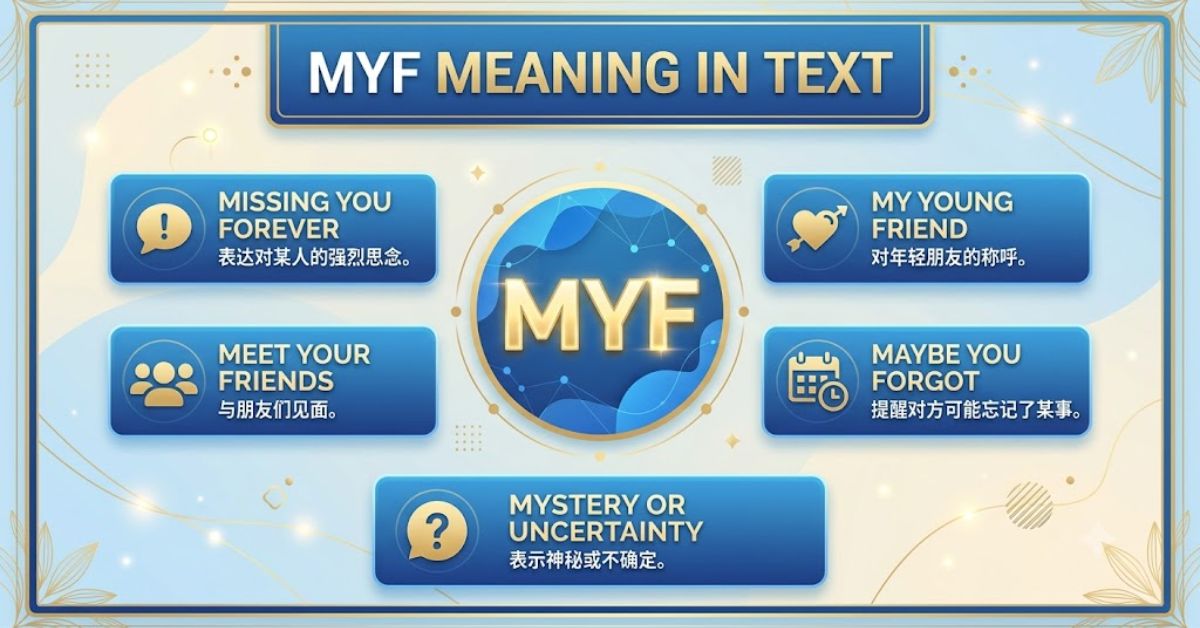

You’re scrolling through a chat, and someone drops “MYF” with zero explanation. No punctuation, no emoji, just three letters. Is it sweet? Sarcastic? An apology? A warning? The MYF meaning in text actually shifts depending on who sent it and what came before it — and getting it wrong can genuinely change how a conversation lands.
This guide breaks down every common meaning, where the term came from, how it shows up across platforms like Snapchat, TikTok, and Discord, and exactly how to reply so you never send an awkward response again.
Quick Answer Box
MYF most often means “Miss Your Face” — a casual, affectionate way of saying you miss someone. It can also mean “My Fault” (a quick, informal apology) or, less commonly, a shortened jab similar to “mind your own business.” The correct meaning almost always depends on tone, emojis, and what was said right before it. When in doubt, read the last two messages in the thread — that context tells you which MYF you’re dealing with.
What Does MYF Mean In Text?
MYF is a three-letter abbreviation that texting culture built for speed. Instead of typing a full sentence, people compress an emotion or reaction into letters that close friends instantly recognize. It functions less like a dictionary word and more like a mood signal.
Because it’s so short, MYF carries almost no built-in tone. That’s exactly why it confuses people who see it out of context. A single acronym doing multiple jobs is common in modern slang — think of how “fine” can mean genuinely fine or clearly not fine. MYF works the same way, leaning entirely on the relationship and the conversation around it.
Most Common MYF Meaning In Text
Common MYF Meaning
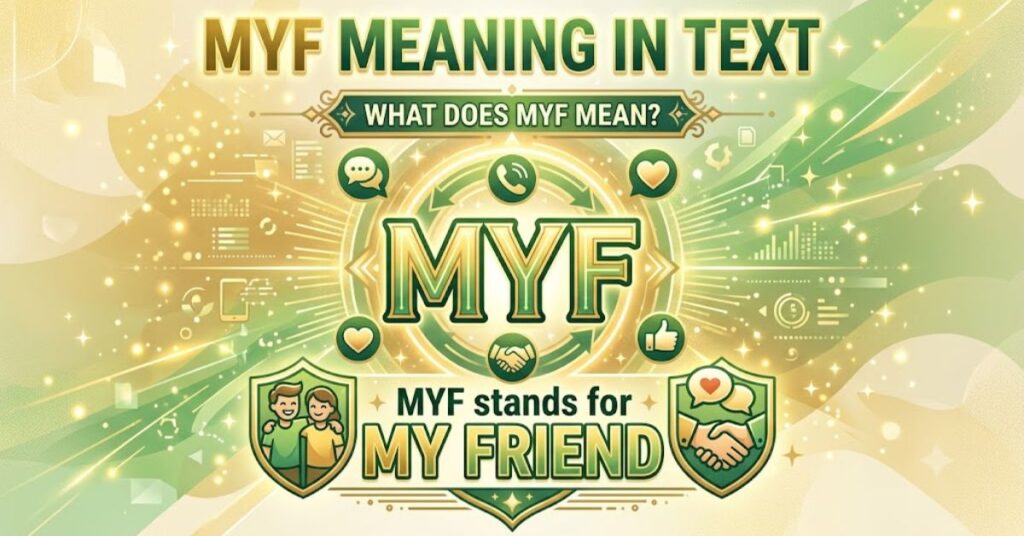
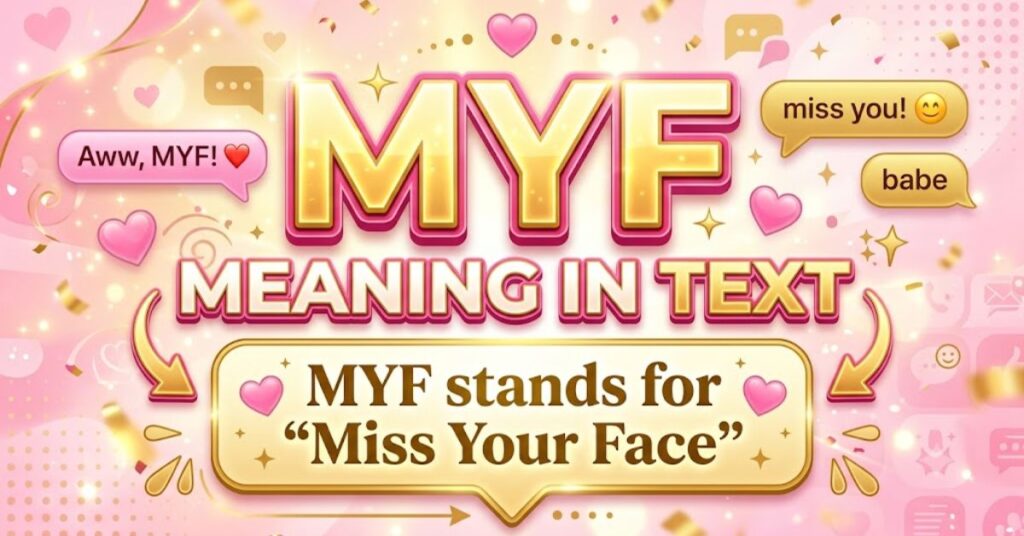
The top meaning, confirmed across most current slang references, is “Miss Your Face.” It’s a warm, slightly playful way to tell someone you miss them without sounding overly serious. Friends, partners, and family use it interchangeably with “miss you,” but with a softer, more casual edge that fits texting better than a full sentence would.
Less Common MYF Meaning
The second most frequent meaning is “My Fault.” People use it to own a small mistake quickly — forgetting to reply, mixing up plans, or spoiling something minor. It reads as a light, low-stakes apology rather than a formal one, which is why it works well in group chats and casual friendships.
Rare MYF Meaning
Less frequently, MYF gets used as a clipped, sharper phrase along the lines of telling someone to mind their own business. This version shows up mostly in heated exchanges or comment sections and depends heavily on aggressive punctuation or a blunt tone to land that way.
Origin And Evolution Of MYF
Like most texting acronyms, MYF grew out of the shift from long messages to fast, emoji-supported chat. As smartphones made texting constant rather than occasional, users compressed common phrases into letters to save time and typing effort. MYF fits a pattern shared by DM, BRB, and IDK — everyday phrases shrunk down for speed.
Its rise tracks closely with the growth of casual messaging apps and social platforms where quick emotional check-ins matter more than full sentences. Over time, the letters picked up more than one meaning because different friend groups adapted the same shorthand for slightly different phrases, which is exactly why context now matters so much when reading it.
Psychological And Emotional Meaning Of MYF
Text lacks tone of voice, so short acronyms like MYF often carry more emotional weight than they appear to on the surface. When someone sends it after a gap in conversation, it usually signals genuine affection or a small pang of missing someone. Sent quickly after a mistake, it signals humility without requiring an emotionally heavy exchange.
Because it’s ambiguous, MYF also acts as an emotional buffer — a way to express feeling without fully committing to vulnerability. That’s part of its appeal for younger texters who want warmth without oversharing.
Communication Function Of MYF
MYF works as a compression tool: it lets people transmit a feeling in three letters instead of a full sentence, which matters in fast-paced chats, group threads, and social captions. It softens intensity too — “my fault” feels heavier than a breezy “myf,” and “I miss you” can feel more loaded than a casual “myf” tossed into a chat.
It also acts as a social signal of closeness. Using MYF assumes the other person will understand it correctly, which is part of why it mostly appears between people who already know each other’s texting style well.
Cultural And Generational Context Of MYF
MYF is used heavily by teens and young adults who grew up texting and messaging as a primary communication method. Older generations are far less likely to recognize it, which is why using MYF with parents, grandparents, or professional contacts often leads to confusion rather than connection.
It also varies slightly by region and online community, with some groups leaning almost entirely toward “Miss Your Face” and others using it more for quick apologies. This generational gap means senders should always consider whether the recipient is fluent in current texting shorthand before using it.
Why MYF Became Popular
MYF caught on because it does double duty: it’s short enough to type in a second, yet expressive enough to carry real emotion. People enjoy acronyms that signal insider knowledge — using and understanding slang like MYF creates a small sense of belonging within a friend group or online community.
Speed also matters. Texting culture rewards brevity, and MYF delivers a full emotional message in a fraction of the keystrokes a complete sentence would need, which keeps conversations flowing naturally.
Semantic Core Meaning Of MYF
At its core, MYF exists to compress a phrase involving personal feeling — affection, apology, or occasionally annoyance — into a form fast enough for casual digital conversation. The unifying thread across all its meanings is emotional shorthand: MYF almost never appears in neutral, factual exchanges. It shows up when a feeling needs expressing quickly.
Most Common MYF Meaning In Text (Deep Dive)
What It Means
“Miss Your Face” is the dominant meaning across text messages, DMs, and captions. It expresses a light, affectionate longing to see or talk to someone again, often used between friends or romantic partners after time apart.
Typical Use Cases
People send it after a call ends, when reminiscing about a friend, or when replying to an old photo. It also appears in captions under throwback posts, signaling nostalgia and warmth toward the person tagged.
Examples In Different Tones
- Casual: “lol miss talking to you, myf”
- Romantic: “can’t wait to see you this weekend, myf 🥹”
- Friendly: “saw this and thought of you, myf”
What It Can Sound Like
Depending on punctuation and emojis, MYF can sound sincere and soft, or light and joking. A heart emoji nudges it toward genuine affection; a laughing emoji keeps it playful and low-pressure.
Meaning Based On Context
Positive Use
Sent with warmth, MYF usually means the sender genuinely misses the person and wants to reconnect. It’s common after long gaps in conversation or physical distance.
Neutral Use
In some group chats, MYF gets tossed around casually as a filler phrase, without deep emotional weight, similar to saying “miss ya” in passing.
Negative Or Critical Use
Rarely, in tense exchanges, a clipped “myf” can carry an edge, especially paired with dismissive punctuation or no emoji at all.
Dry Or Rushed Use
Sent without context mid-conversation, MYF sometimes just fills space or acknowledges a message quickly, without strong emotional intent either way.
How MYF Is Used In Real Conversations
Understanding Or Clarifying
When confused, most people simply scroll up to the previous few messages, since MYF’s meaning almost always tracks the emotional direction of what was just said.
Reacting Or Labeling
Some use MYF as a quick emotional label on a memory, photo, or shared moment, rather than as part of an ongoing back-and-forth.
Social Or Dating Context
In dating conversations, MYF often signals interest or fondness, especially when paired with plans to meet up again soon.
Group Or Online Context
In larger group chats, MYF tends to lose personal weight and becomes more of a friendly, low-stakes phrase used among several people at once.
Gaming Context
In gaming chats, MYF sometimes shows up as a quick “my fault” after a missed shot or mistake, keeping the tone light during fast-paced play.
Read more.430+ Tomato Puns: Cute One-Liner Instagram Captions for Kids
MYF Meaning On Different Platforms
MYF Meaning On Snapchat
On Snapchat, MYF usually leans toward “Miss Your Face,” often sent alongside a selfie or old photo as a nostalgic caption.
MYF Meaning On TikTok
In TikTok comments, MYF frequently appears under emotional or nostalgic videos, expressing affection toward a friend tagged in the comments.
MYF Meaning On Instagram
On Instagram, MYF shows up in captions and comments under throwback photos, functioning almost like a mini tribute to a friendship or relationship.
MYF Meaning In Texting Or Messaging
In direct texts, MYF is more personal and immediate, often used right after a call or in response to missing someone during the day.
MYF Meaning On Discord Or Communities
In Discord servers, MYF sometimes shifts toward the apology meaning, especially in gaming or hobby communities where quick, casual exchanges are the norm.
When To Use Vs When To Avoid MYF
| Situation | Use MYF? | Why |
|---|---|---|
| Texting a close friend | Yes | Familiar, casual, low-risk |
| Romantic partner after time apart | Yes | Warm and affectionate |
| Work email or Slack | No | Too informal, easily misread |
| Serious apology needed | No | Feels dismissive |
| New acquaintance | Caution | May not understand it |
When To Use
Use MYF with people who already understand casual texting shorthand — close friends, partners, or familiar group chats — where a quick emotional check-in fits the vibe.
When To Avoid
Avoid it in professional messages, formal emails, or serious apologies, since it can come across as careless or confusing to anyone unfamiliar with current slang.
Professional And Safe Alternatives
Swap MYF for full phrases like “I miss you,” “that’s my mistake,” or “I apologize for that” in any setting where clarity and professionalism matter more than speed.
Hidden Or Risky Meanings Of MYF
In rare cases, particularly in heated comment sections, MYF gets used as shorthand for a dismissive phrase telling someone to back off. This version depends almost entirely on aggressive tone cues, so it’s worth reading the full exchange before assuming this darker meaning applies.
Read more.450+ Owl Puns & One-Liners for Instagram, Birthdays & Kids
Variations And Forms Of MYF
Common variations include “MYFF” for extra emphasis, “myf frl” (for real) to stress sincerity, and pairing it with emojis like 🥹 or 😭 to clarify an affectionate tone rather than a sarcastic one.
MYF Vs Similar Slang
| Term | Meaning | Tone |
|---|---|---|
| MYF | Miss Your Face / My Fault | Warm or apologetic |
| IMY | I miss you | Direct, sincere |
| MB | My bad | Casual apology |
| FYI | For your information | Neutral, informative |
How To Decode The Correct Meaning
To decode MYF accurately, check three things: the previous message, the emojis attached, and how well you know the sender’s texting style. An apology usually follows a mistake or mix-up; affection usually follows a gap in conversation or a nostalgic photo.
How To Respond To MYF
Casual Replies
“aww myf too” or “same, miss you” both work well for light, friendly exchanges.
Friendly Replies
“omg stop I miss you so much” adds warmth without overthinking the reply.
Mature Or Respectful Replies
“I appreciate that, I miss you too” fits slightly more formal or newer relationships.
Boundary Or Privacy Responses
If the tone feels off or unclear, a simple “what do you mean by that?” clears up any confusion instantly.
Common Misunderstandings About MYF
The biggest mistake is assuming MYF always means the same thing regardless of context. Another common error is using it in professional settings, where it reads as unclear or unprofessional rather than casual. People also sometimes confuse it with unrelated acronyms that look similar at a glance.
Read more.399+ Trash Puns: Funny One Liners, Garbage Jokes, Captions, and Rubbish Puns That Don’t Stink
Regional And Cultural Usage Of MYF
Usage leans heaviest among younger, English-speaking texters in the U.S., U.K., and other predominantly online youth cultures. Some communities favor the affectionate meaning almost exclusively, while others use it more for quick apologies, so localized context always helps confirm the intended meaning.
Frequently Asked Questions
What does MYF mean in a text message?
MYF most commonly means “Miss Your Face,” a casual way of saying you miss someone.
Does MYF always mean “Miss Your Face”?
No — it can also mean “My Fault,” depending on context and tone.
Is MYF rude or offensive?
Not typically. It’s only sharp-edged in rare, tense exchanges with dismissive tone cues.
Can MYF be used in a romantic context?
Yes, it’s commonly used between partners to express affection casually.
Is it okay to use MYF at work?
No, it reads as too informal and can confuse colleagues unfamiliar with the term.
How do I know which MYF meaning someone intends?
Check the previous message and any attached emojis for tone clues.
Is MYF popular on all platforms?
It’s most common on Snapchat, Instagram, TikTok, and casual texting, less so on formal platforms.
What’s a good reply to MYF?
“Miss you too” or “aww, same” both work naturally in casual conversation.
Is MYF only used by teens?
It’s most popular among teens and young adults, though some older texters use it too.
What should I do if I’m unsure what MYF means?
Simply ask the sender — it’s a quick, low-pressure way to clear up any confusion.
Conclusion
The MYF meaning in text isn’t fixed — it shifts between “Miss Your Face,” “My Fault,” and, rarely, a sharper dismissal, depending entirely on context, tone, and who’s texting. Reading the message before it and paying attention to emojis will almost always tell you which version you’re looking at.
Used with the right people at the right time, MYF is a quick, warm way to express affection or own a small mistake without overcomplicating a simple text.

