


If you have ever paused mid-sentence wondering whether something happens “pre” or “post” an event, you are not alone. The pre and post meaning confusion trips up students writing lab reports, employees drafting business timelines, and even patients trying to understand a doctor’s instructions. These two small prefixes carry a lot of weight — get them backwards, and a sentence can say the exact opposite of what you intended.
In this guide, you will learn exactly what “pre” and “post” mean, why the distinction matters, and how these prefixes show up in daily conversation, education, business, medicine, technology, and social media. You will also find real-world examples, a comparison table, and answers to the most common questions people ask about pre and post meaning. By the end, you will be able to use both terms correctly and confidently in any context.
What Does Pre Mean?
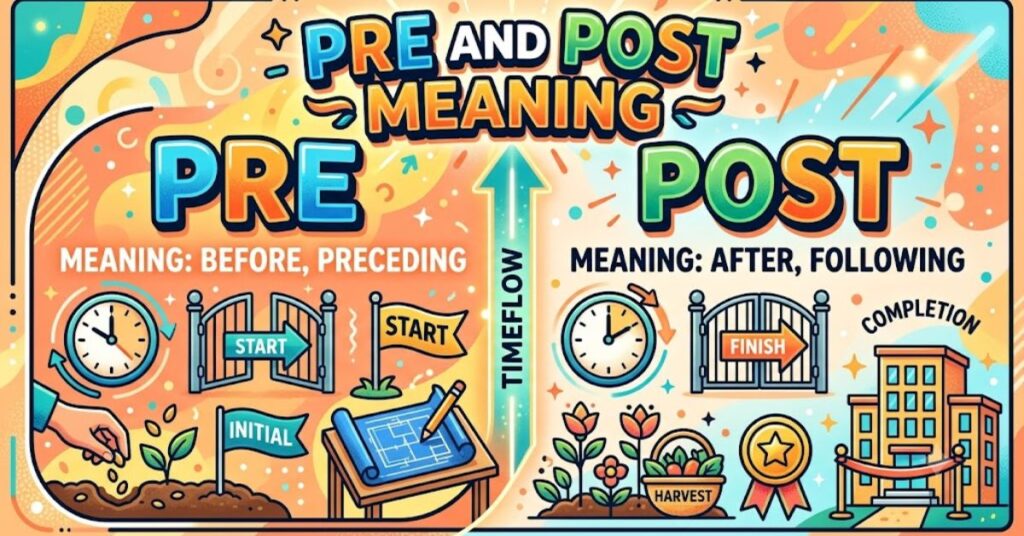
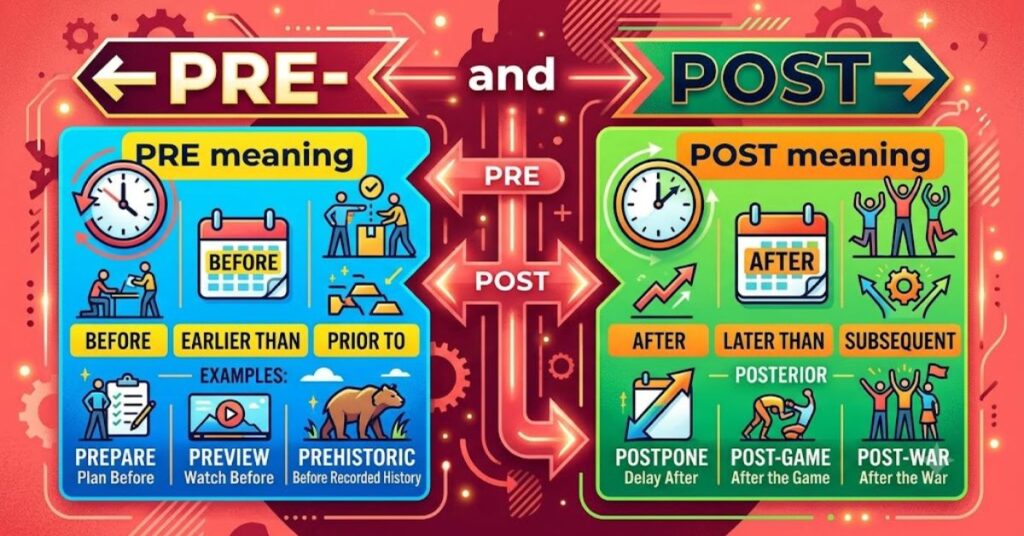
The prefix “pre” comes from the Latin word for “before” and is used to describe something that happens, exists, or is prepared ahead of a specific event or point in time. When you attach “pre” to a word, you are telling the reader or listener: this comes first, this is preparation, this is anticipation.
You see it everywhere. A “pre-order” means buying something before it is officially released. A “pre-flight check” happens before a plane takes off. “Pre-heating” an oven means warming it before you start cooking. In each case, the prefix signals that an action is happening in advance of the main event.
Understanding pre meaning is especially useful because it often implies planning, readiness, or precaution. Businesses use “pre-launch” campaigns to build excitement before a product drops. Schools use “pre-requisites” to describe courses students must complete before enrolling in advanced classes. In almost every field, “pre” is the word you reach for when you are describing the setup phase.
What Does Post Mean?
“Post” is the natural counterpart to “pre.” Derived from the Latin “post,” meaning “after” or “following,” this prefix marks anything that occurs once an event has already taken place. If “pre” is about preparation, “post” is about reflection, reaction, and results.
Think about “post-game” interviews, which happen after a match ends, or “post-surgery” recovery, which begins once an operation is complete. “Postpartum” refers to the period after childbirth, and “post-mortem” analysis happens after something has concluded, whether that is a person’s life or a failed business project.
The post meaning is closely tied to outcomes and consequences. Where “pre” asks “what do we need to do before this happens,” “post” asks “what happened as a result, and what do we do now.” This is why post-event reports, post-purchase reviews, and post-treatment checkups all exist — they capture information that can only be gathered once the event itself is finished.
Read more.WTD Meaning in Chat: A Complete Guide to This Popular Internet Slang
Importance of Pre and Post
Why do these two tiny prefixes deserve an entire article? Because clarity depends on them. Confusing pre and post meaning in the wrong context can lead to serious miscommunication, missed deadlines, or in some fields, real safety risks.
Here is why getting it right matters:
- Precision in communication: Saying “pre-treatment” instead of “post-treatment” changes the entire meaning of a medical instruction.
- Better planning: Knowing what needs to happen before and after an event helps teams organize timelines accurately.
- Fewer costly mistakes: In business and law, mixing up pre and post terms can affect contracts, approvals, and compliance.
- Stronger academic performance: Students who understand pre-test and post-test structures can track their own learning progress more effectively.
- Clearer everyday conversation: Even casual phrases like “pre-party” or “post-workout” rely on the listener understanding the correct sequence of events.
In short, pre and post are not just grammar trivia. They are functional tools that keep instructions, plans, and records accurate across nearly every part of life.
Pre and Post Meaning in Daily Life
Most people use “pre” and “post” dozens of times a week without even noticing. These prefixes have become part of everyday shorthand because they save time and add precision compared to writing out “before” or “after” in full.
Examples of Pre in Daily Life
- Pre-breakfast walk – a walk taken before eating breakfast
- Pre-departure checklist – tasks completed before leaving for a trip
- Pre-wash cycle – the rinse stage before the main laundry cycle
- Pre-shopping list – a list made before heading to the store
- Pre-nap routine – calming activities done before a child’s nap
- Pre-drinks – informal social drinks before heading out for the night
- Pre-shift briefing – a quick meeting before a work shift begins
- Pre-bedtime skincare – a routine followed before sleeping
Examples of Post in Daily Life
- Post-dinner walk – a walk taken after eating dinner
- Post-vacation blues – the low mood people feel after returning from a trip
- Post-workout stretch – stretching done right after exercising
- Post-shower routine – skincare or haircare done after bathing
- Post-party cleanup – tidying up after guests leave
- Post-holiday budget – reviewing finances after a holiday season
- Post-meeting notes – summaries written after a discussion ends
- Post-nap grogginess – the sluggish feeling right after waking from a nap
Read more.399+ Trash Puns: Funny One Liners, Garbage Jokes, Captions, and Rubbish Puns That Don’t Stink
Pre and Post Meaning in Education
In classrooms and training programs, pre and post meaning shows up constantly, especially when measuring how much a student has learned. A “pre-test” is given before instruction begins to establish a baseline. A “post-test” is then given afterward to measure improvement. The gap between the two scores tells teachers exactly how effective a lesson was.
Beyond testing, schools rely on “prerequisites,” which are courses or skills students must complete before moving to the next level. On the other side, “post-graduate” studies refer to degrees pursued after finishing an undergraduate program. Even simple classroom routines, like a “pre-reading” activity to build background knowledge or a “post-reading” discussion to check comprehension, depend on students and teachers understanding which side of the lesson they are on.
This distinction is also critical in curriculum design. Educators build “pre-assessment” tools to identify gaps before teaching a topic and “post-assessment” tools to confirm those gaps have closed. Without a clear grasp of pre and post meaning, it becomes difficult to track academic growth accurately.
Pre and Post Meaning in Business
Business communication leans heavily on these prefixes to describe timelines, approvals, and performance tracking. Getting them right keeps contracts, reports, and internal communication accurate.
Pre Examples
- Pre-approval – confirmation given before a final agreement or loan is issued
- Pre-launch marketing – promotional activity before a product goes live
- Pre-negotiation – informal discussions before a formal deal is signed
- Pre-audit review – an internal check before an official audit begins
- Pre-sales support – assistance offered to customers before they purchase
Post Examples
- Post-launch analysis – reviewing performance data after a product release
- Post-sale service – customer support offered after a purchase is complete
- Post-merger integration – combining two companies’ operations after a merger closes
- Post-quarter report – financial summary created after a business quarter ends
- Post-project review – evaluating what worked and what did not after a project wraps up
Mixing these up can cause real problems. Saying a deal is in “pre-approval” when it is actually “post-approval” could mislead a client into thinking a contract is not yet finalized when it actually is.
Pre and Post Meaning in Medicine
Nowhere is the pre and post meaning distinction more important than in healthcare, where mixing up the two prefixes can genuinely put patients at risk. Doctors, nurses, and medical staff rely on precise language to communicate timing around procedures, medications, and recovery.
Read more.395 Moon Puns & Jokes: Funny One-Liners, Captions, Instagram & Love
Examples of Pre in Medicine
- Pre-operative (pre-op) instructions – guidance given before surgery, such as fasting rules
- Pre-existing condition – a health issue that existed before a new diagnosis or insurance policy
- Pre-natal care – medical checkups during pregnancy, before childbirth
- Pre-medication – drugs given before a procedure to reduce risk or discomfort
- Pre-screening – tests conducted before a treatment plan is finalized

Examples of Post in Medicine
- Post-operative (post-op) care – recovery instructions given after surgery
- Postpartum recovery – the physical and emotional recovery period after childbirth
- Post-treatment monitoring – follow-up checkups after therapy or medication has ended
- Post-mortem examination – an autopsy conducted after death to determine its cause
- Post-vaccination observation – monitoring a patient for reactions after receiving a vaccine
In clinical settings, confusing “pre-op” and “post-op” instructions is not just a grammar slip — it can mean a patient eats when they should be fasting, or skips medication they actually need. This is exactly why hospitals train staff to be exact about pre and post meaning in every chart and conversation.
Pre and Post Meaning in Technology
The tech industry has adopted “pre” and “post” as standard shorthand for describing stages in a process, especially in software development, data handling, and product releases.
Developers talk about “pre-processing” data, which means cleaning and organizing raw data before it is fed into a system or model. Once the system produces results, “post-processing” refines that output into a usable format. Similarly, software companies release “pre-release” or “beta” versions of an app before the official launch, followed by “post-release” updates and patches once real users start reporting bugs.
In gaming, “pre-order bonuses” reward players who buy a game before release, while “post-launch content” refers to updates, expansions, or downloadable content released after the game is already available. Even in cybersecurity, teams run “pre-deployment” security scans before pushing code live, then conduct “post-incident” reviews after any breach or outage to understand what went wrong.
Pre vs Post Meaning in Social Media
Social media has given “pre” and “post” a slightly different flavor, closely tied to content creation and audience engagement. Creators talk about “pre-production,” the planning and filming stage before a video goes live, versus “post-production,” the editing and polishing stage after filming wraps but before publishing.
Brands also track “pre-launch buzz,” the anticipation built through teaser content before a product reveal, compared to “post-launch engagement,” which measures likes, shares, and comments after the content is published. Influencer marketing campaigns are often judged by comparing pre-campaign follower counts to post-campaign follower counts to measure real impact.
There is also a fun overlap worth noting: the word “post” doubles as a noun in social media (as in “I made a post”), separate from its use as a time-based prefix meaning “after.” This dual meaning occasionally causes confusion, especially for new social media managers still learning platform terminology.
Key Differences Between Pre and Post
Here is a simple side-by-side comparison to lock in the distinction between these two prefixes.
| Aspect | Pre | Post |
|---|---|---|
| Meaning | Before an event | After an event |
| Origin | Latin, “prior to” | Latin, “posterior,” meaning later |
| Common use | Preparation, anticipation | Reflection, results, consequences |
| Education example | Pre-test | Post-test |
| Medical example | Pre-operative care | Post-operative care |
| Business example | Pre-approval | Post-sale service |
| Tone | Forward-looking | Backward-looking |
| Typical questions answered | What do we need before this? | What happened because of this? |
Common Misunderstandings About Pre and Post
Even fluent English speakers slip up with these prefixes from time to time. Here are the most frequent mistakes people make:
- Assuming “post” is always a noun. People forget “post” can function as a time-based prefix (post-surgery) as well as a standalone word for a written update (a social media post) or a mail service.
- Using “pre” and “post” as exact opposites in every case. While they often sit on opposite sides of the same event, they are not always symmetrical opposites in meaning or usage.
- Skipping the hyphen inconsistently. Some fields, like computing, write “preprocessing” as one word, while others insist on “pre-processing” with a hyphen. Both are used, but consistency within a single document matters.
- Mixing up sequence in instructions. Saying “pre-approval after submission” is contradictory, since approval described as “pre” should logically happen before submission, not after.
- Overusing the prefixes in casual writing. Not every sentence needs “pre” or “post” attached; sometimes plain “before” and “after” read more naturally.
Final Thoughts
Understanding pre and post meaning is a small investment that pays off in nearly every area of communication, from casual conversation to medical charts and business contracts. “Pre” points backward in time to preparation and anticipation, while “post” points forward from an event to its results and aftermath.
Once you internalize this distinction, using these prefixes correctly becomes second nature, whether you are writing a pre-test for students, scheduling post-operative care for a patient, or planning a pre-launch campaign for a new product. Keep the comparison table in this guide handy, and you will never second-guess these two prefixes again.
FAQs
What is the basic difference between pre and post?
“Pre” means before an event, and “post” means after it. They mark opposite sides of the same point in time.
Is “pre” always used as a prefix?
Mostly yes, though it can occasionally stand alone in casual speech, such as saying a child is “in pre” to mean preschool.
Does “post” always mean “after”?
Not always. “Post” can also be a standalone noun, like a social media post or a fence post, unrelated to timing.
What does pre-op and post-op mean in medicine?
Pre-op refers to the period before surgery, while post-op refers to the recovery period after surgery is completed.
Why do businesses use pre and post terms so often?
These prefixes help clarify timelines around approvals, launches, and reviews, reducing confusion in contracts and reports.
What is the difference between a pre-test and a post-test?
A pre-test measures knowledge before instruction, while a post-test measures knowledge after instruction to track improvement.
Can pre and post be used interchangeably?
No, using them interchangeably usually reverses the meaning of a sentence and can cause serious miscommunication.
Are pre and post hyphenated?
Sometimes. Common terms like “post-op” or “pre-order” often use a hyphen, though technical fields sometimes drop it.
What is post-production in content creation?
Post-production refers to editing, refining, and finalizing video or audio content after filming or recording is complete.
Why is understanding pre and post meaning important in daily life?
It helps you communicate clearly about timing, whether you are scheduling tasks, describing routines, or giving instructions to others.

