
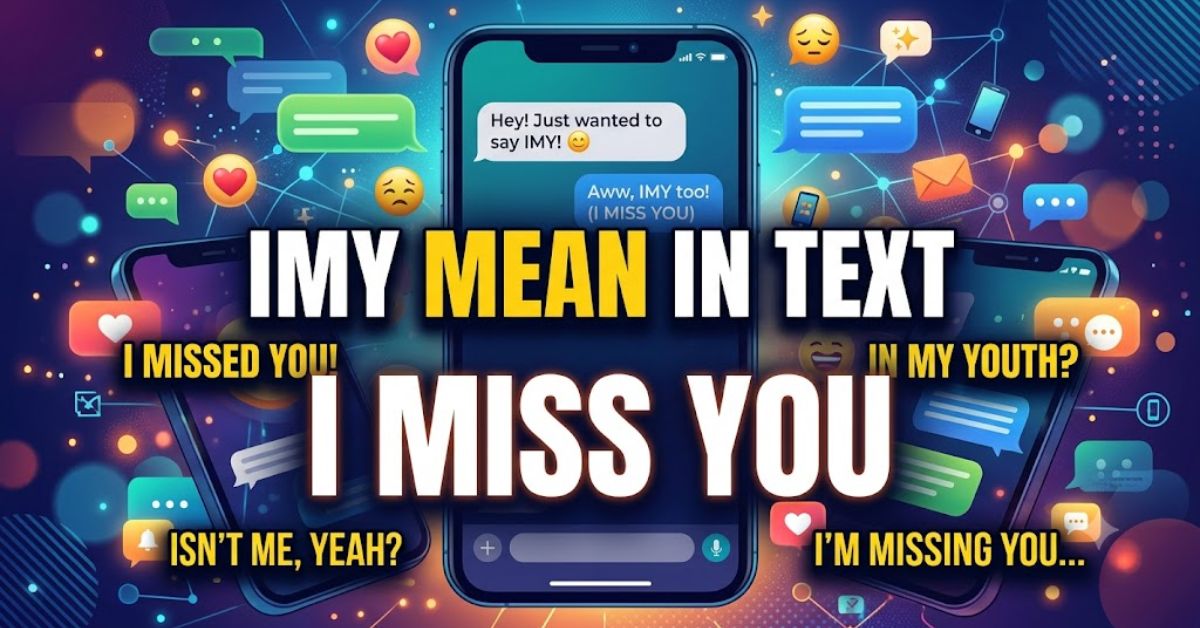

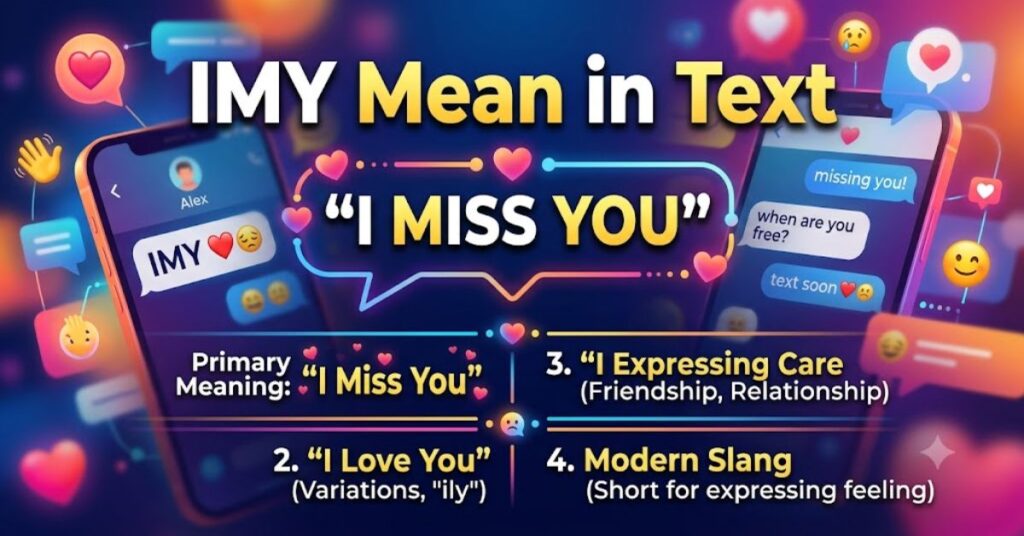
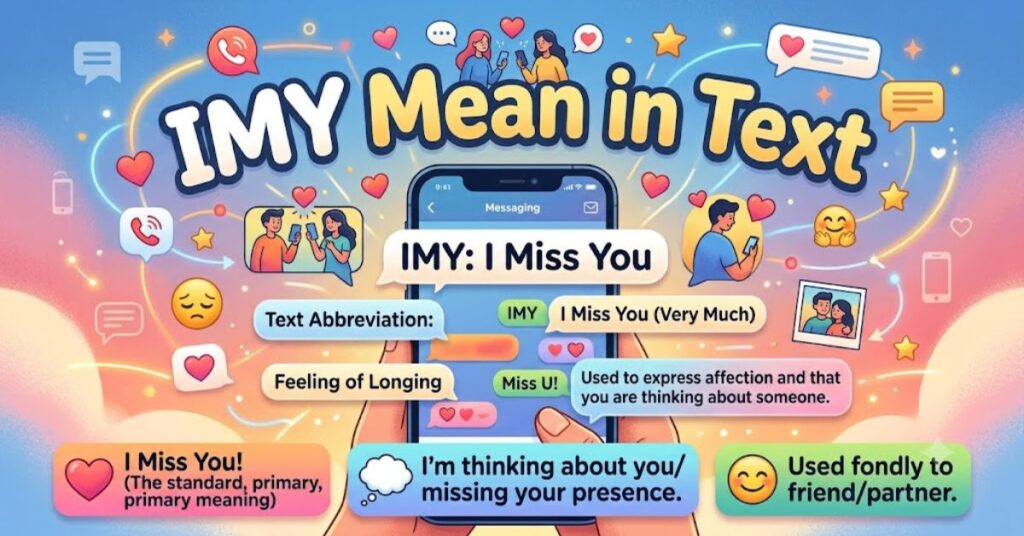
IMY meaning in almost every text is “I miss you.” Someone types it to say you’re on their mind.
It’s warm, casual, and works between friends, family, or partners. Rare spinoffs exist, but this is the one you’ll see 95% of the time.
- Most common: I miss you
- Also common: I miss you (friendly, non-romantic tone)
- Rare: I’m yours, I’m yelling, I’m young
- Tone: affectionate, casual, sometimes flirty
What Does IMY Mean In Text?
IMY is short for “I miss you.” People type it instead of writing the full phrase because it’s faster and still lands with the same feeling.
You’ll see it everywhere — texts, Snapchat captions, Instagram comments, even quick DMs after a long day apart from someone you care about.
Most Common IMY Meaning In Text
The overwhelming majority of the time, IMY means exactly what it looks like: “I miss you.” No hidden layer, no trick. Someone sends it because they’re thinking about you and want you to know.
It shows up between partners, friends, and family alike. “Imy, call me later” reads just like typing the full sentence, only quicker.
Common IMY Meaning
Beyond romantic use, IMY works just as often in friendly, non-romantic contexts. Friends who haven’t talked in a while send it as a low-key way to reconnect.
- “Imy dude, we need to hang out”
- “Haven’t seen you in forever, imy”
Less Common IMY Meaning
Occasionally, people stretch it into IMYY or IMYSM for extra emphasis. The extra letters signal a stronger feeling than a plain IMY would.
You’ll mostly catch these variations in close relationships or after longer stretches of not talking.
Rare IMY Meaning
In niche corners of teen slang, IMY has jokingly stood for “I’m yelling” as a reaction to something shocking or funny. It’s rare and almost always obvious from context.
On dating apps, some people playfully use it to hint at “I’m yours,” though this reading depends entirely on flirty context and isn’t standard.
Origin And Evolution Of IMY
IMY grew out of the same habit behind most texting slang: shortening common phrases to save time and keystrokes. “I miss you” is long enough that people naturally compressed it.
As texting replaced phone calls for everyday check-ins, quick emotional shorthand like IMY filled the gap. It let people express feeling without writing a full message every time.
Social media accelerated the trend further. Captions, stories, and quick replies favor short, punchy phrases, so IMY spread fast across platforms and generations, eventually becoming one of the most recognized slang terms for missing someone.
Psychological And Emotional Meaning Of IMY
IMY carries real emotional weight even though it’s just three letters. Sending it signals vulnerability — you’re admitting someone’s absence affects you.
That’s part of why it can feel meaningful even in a short, casual message. It says “you matter to me” without requiring a long, drawn-out explanation.
At the same time, tone shapes how much weight it carries. A quick, throwaway “imy” between friends feels light. The same word from a partner late at night can feel a lot heavier and more sincere.
Communication Function Of IMY
IMY exists to communicate longing quickly and without friction. It softens distance, whether that distance is physical or just a gap in conversation.
- Efficiency: expresses a full feeling in three letters
- Connection signal: reminds someone they’re still valued
- Emotional shorthand: avoids over-explaining a feeling
It also works as an icebreaker after silence. Texting “imy” after a few quiet days is often easier than writing a longer message explaining why you went quiet.
Cultural And Generational Context Of IMY
IMY is especially common among Gen Z and younger millennials, though it’s understood widely across age groups by now. It fits naturally into how younger users express emotion online.
Older generations tend to write out “I miss you” in full, while younger texters default to the abbreviation almost automatically, especially in casual or fast-moving chats.
Culturally, it reflects a broader shift toward expressing feelings quickly and often, rather than saving emotional statements for big moments. Frequent, small check-ins like IMY have become normal in how people stay close today.
Why IMY Became Popular
A few clear reasons explain why IMY caught on so widely.
- It’s fast to type and easy to recognize instantly
- It fits naturally into texting and social captions
- It expresses emotion without feeling overly formal
- Long-distance friendships and relationships rely on it heavily
As more relationships play out partly or fully over text, shorthand for emotional check-ins became essential. IMY filled that need perfectly, and its popularity has only grown since.
Semantic Core Meaning Of IMY
At its root, IMY always points back to one idea: absence paired with affection. Someone isn’t there, and that absence is felt enough to mention.
Every variation, from IMYY to the rare “I’m yours,” still circles back to closeness and connection in some form. The core sentiment rarely strays far from missing or valuing someone.
That consistency is part of what makes IMY easy to decode, even with its rare alternate meanings. The emotional thread stays the same across nearly every use.
Most Common IMY Meaning In Text (Deep Dive)
Since “I miss you” covers almost every case, it’s worth unpacking properly. Here’s what it looks like in real conversations and different emotional tones.
What It Means
When IMY means “I miss you,” it functions as a direct emotional statement. There’s no hidden agenda — the sender simply wants you to know you’ve been on their mind.
It often appears alone or paired with a short follow-up, like a question about when you’ll talk or see each other next.
Typical Use Cases
- Reconnecting after a few quiet days
- Checking in during a long-distance relationship
- Reminiscing with an old friend
- Ending a conversation on a warm note
Examples In Different Tones
Sweet: “Imy so much, can’t wait to see you 💕” Casual: “Imy, we should catch up soon.” Sad: “Imy… today’s been rough without you.” Playful: “Imy, but also you owe me a text back lol.”
What It Can Sound Like
A short, plain “imy” with no punctuation can read as sincere but low-key. Add an emoji or exclamation point, and it shifts toward excited or affectionate instead.
Context around it, like a follow-up question or story reference, usually clarifies exactly how much emotional weight the sender intended.
Read more:BBJ Meaning in Text: What It Stands for and How People Use It Online
Meaning Based On Context
The same three letters shift tone depending on the relationship and the moment.
Positive Use
“Imy so much, let’s plan something this weekend!” This reads warm and hopeful, often paired with a plan to reconnect soon.
Neutral Use
“Imy, hope work’s going okay.” Friendly but low-intensity, more of a passing thought than a deep emotional statement.
Negative Or Critical Use
“Imy but you never text back first.” Here it’s mixed with mild frustration, showing affection alongside a complaint.
Dry Or Rushed Use
“Imy, gotta run.” Quick and genuine, but clearly not the focus of the message at that moment.
How IMY Is Used In Real Conversations
Real chats show IMY doing slightly different emotional jobs depending on who’s talking and why.
Understanding Or Clarifying
Friend: “Wait, imy like a lot or just a little? 😂” You: “A lot lol, we haven’t hung out in weeks.”
Reacting Or Labeling
Friend: “That old photo just popped up, imy so much right now.”
Social Or Dating Context
Partner: “Long day, imy, can’t wait to see you tonight.”
Group Or Online Context
Group chat: “Old squad pic just resurfaced, imy all so much 🥺”
Gaming Context
Teammate: “Haven’t played with you in forever, imy on the team lol.”
IMY Meaning On Different Platforms
Where IMY shows up shapes how intense or casual it reads.
IMY Meaning On Snapchat
On Snapchat, IMY often pairs with an old photo or memory, triggering a quick nostalgic message to a friend or partner.
IMY Meaning On TikTok
TikTok comments often use IMY under nostalgic or throwback videos, expressing missing a person, a time, or a shared moment.
IMY Meaning On Instagram
Instagram captions and DMs use IMY both romantically and platonically, frequently alongside old photos or “flashback” posts.
IMY Meaning In Texting Or Messaging
In standard texting, IMY stays close to its core meaning — a direct, personal message to someone specific.
IMY Meaning On Discord Or Communities
In Discord, IMY sometimes extends to whole communities or servers, expressing missing an active group rather than just one person.
When To Use Vs When To Avoid IMY
Knowing where IMY fits keeps your messages sounding natural instead of out of place.
When To Use
- Texting close friends, family, or partners
- Reconnecting after time apart
- Casual, personal social media captions
- Warm, low-pressure check-ins
When To Avoid
- Professional emails or workplace chats
- New or unfamiliar contacts
- Formal messages where clarity matters most
- Situations where the relationship doesn’t support that level of warmth
Professional And Safe Alternatives
In formal settings, swap IMY for “I hope you’re doing well” or “looking forward to reconnecting.” These keep warmth without the casual slang tone.
Hidden Or Risky Meanings Of IMY
Most of the time, IMY is completely safe and sincere. Still, a few situations are worth flagging.
Sending IMY to an ex or someone you’re no longer close with can send mixed signals, especially if the relationship ended on rocky terms. It’s worth thinking through intent before hitting send in those cases.
The rare “I’m yours” reading can also come off as forward or flirty if the other person isn’t expecting it, so it’s best reserved for situations where that tone is already clearly welcome.
Variations And Forms Of IMY
IMY has picked up a handful of common spinoffs over time.
- IMYY — extra emphasis, stronger feeling
- IMYSM — I miss you so much
- IMYMTA — I miss you more than anything
- IMU — an alternate short form using “u” instead of “you”
Read more:PTSO Meaning Slang: What It Really Means in 2026
IMY Vs Similar Slang
IMY sits alongside other emotional shorthand, though each carries a distinct meaning.
| Slang | Core Meaning | Typical Tone |
|---|---|---|
| IMY | I miss you | Warm, affectionate |
| ILY | I love you | Deeper, more serious |
| TY | Thank you | Neutral, polite |
| WYD | What are you doing | Casual, conversational |
Unlike ILY, which signals love directly, IMY focuses specifically on absence and longing rather than affection as a whole.
How To Decode The Correct Meaning
If you’re ever unsure which reading applies, run through this quick check:
- Look at who sent it and your relationship with them
- Check the surrounding words for context clues
- Consider the platform — nostalgic posts often mean literal missing
- Read the tone — playful phrasing usually softens the meaning
In the vast majority of cases, “I miss you” is the safe, correct answer.
How To Respond To IMY
How you respond depends on your relationship and how you feel about the message.
Casual Replies
“Aw, imy too!” or “Missed you more lol.”
Friendly Replies
“Same! We really need to catch up soon.”
Mature Or Respectful Replies
“That’s sweet, I’ve been thinking about you too” works well for slightly more serious or meaningful conversations.
Boundary Or Privacy Responses
If the message feels unwelcome or comes from someone you’d rather keep distance from, a simple “thanks, take care” keeps things polite without opening the door further.
Read more:HN Meaning in Text: The Ultimate Guide to Understanding This Popular Slang 💬
Common Misunderstandings About IMY
The biggest misunderstanding is assuming IMY always means something deeply romantic. In reality, friends and family use it just as often, with zero romantic intent behind it.
Some people also worry a short “imy” with no follow-up means something’s wrong. Usually, it’s just a quick thought someone wanted to share in the moment, nothing more complicated than that.
Rare meanings like “I’m yelling” or “I’m yours” trip people up occasionally, but context almost always makes the intended meaning obvious within a message or two.
Regional And Cultural Usage Of IMY
In the US, IMY is used broadly across age groups, though it’s especially common among teens and young adults texting daily. Long-distance friendships and relationships lean on it heavily.
In the UK and Australia, IMY follows similar patterns, though “miss you” written out in full still shows up more often in slightly older or more formal messaging styles. Online, especially on TikTok and Instagram, regional differences fade since the slang spreads globally through shared platforms.
Frequently Asked Questions
What does IMY mean in a text message?
It stands for “I miss you,” used to express you’re thinking about someone.
Is IMY only for romantic relationships?
No, friends and family use it just as often, with a friendly, non-romantic tone.
Is IMY too casual to send someone new?
Yes, it works best with people you already have a close relationship with.
Should I use IMY at work?
Avoid it. Write out “I hope you’re doing well” instead in professional settings.
What does IMYY mean?
It’s an extended version of IMY, adding emphasis to show a stronger feeling of missing someone.
Conclusion
IMY comes down to one simple, sincere idea: someone’s thinking about you and wants you to know it. The core meaning barely changes across friends, family, or partners.
Once you know the context clues to watch for, tone, relationship, and platform, decoding it takes seconds. Use it freely with people close to you, skip it in professional settings, and it’ll always land the way it’s meant to.

